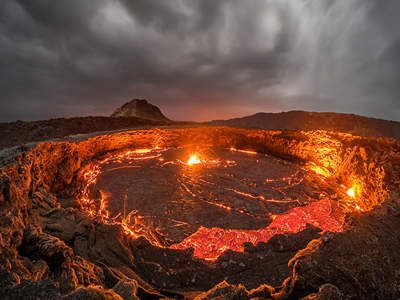
 One of Africa's most striking geographical features is a giant tear across the earth's surface visible even from space: the Great Rift Valley. Extending from the Middle East to Mozambique, the Rift Valley passes in a north-easterly to South-westerly direction right through Ethiopia, endowing the country with some spectacular sights range from hot, dry, and barren places to a string of beautiful lakes. This tremendous collapse of the earth's surface occurred at the same time that the Arabia Peninsula, geologically a part of Africa. The Afar Depression is a plate tectonic triple junction where the spreading ridges that are forming the Red Sea and the Gulf of Aden emerge on land and meet the East African Rift. The Afar Depression is one of two places on Earth where a mid-ocean ridge can be studied on land, the other being Iceland. At present, the Afar is slowly being pulled apart at a rate of 1-2 cm per year. The floor of the Afar Depression is composed mostly of basaltic lava. The Afar Depression and Triple Junction also mark the location of a mantle plume, a great uprising of mantle that melts to yield basalt.
This place which used to be part of the Red Sea has kilometers of salt deposits’. In some places the slat deposit’s are about 3miles (5 KMS) thick. Below a salt lake is a substantial source of volcanic heat which causes hot water to rise through layers of salt and anhydrite deposits. Minerals get dissolved and are deposited, near the springs, and form shapes very much reminiscent (but smaller than) hornitos on basaltic lava flows. Sulphur, other minerals and possibly Thermopylae bacteria cause spectacular colors, Sundered from the rest of the continent. In Eastern Ethiopia, near the southern end of the Red Sea, an immense, more or less triangular depression descends far below sea level (at some points 120 meter below sea level). Known as the Danakil Depression, this extremely hot and dry area is actually a part of the Africa's Great Rift Valley. In this seemingly inhospitable area there live the nomadic Afar people who number about 3 million. Their external borders are Eritrea, Djibouti, and Somalia. The region where these people live is also called Afar-one of the nine regions of Ethiopia. Its current capital is named Semera on the paved Awash - Assab highway. The Danakil, or Dallol, depression, which encompasses a good portion of the eastern part of the Tigray region, is one of the earth's hottest and most inhospitable places, with many points more than 100 meters (328 feet) below sea level and noon-time temperatures soaring above 50 degree Celsius (122 degree Fahrenheit)
It is the site of a dry salt lake from which Ethiopians since time immemorial have obtained their amoles, or bars of salt, used both for consumption and, long ago, as a primitive sort of money. Minded by the Afar people for at least a millennium and a half, the salt is loaded on camels and taken to the highlands with long caravans, where it is still in considerable demand and fetches a good price.
A special place called "Erta Ale" (one of the most important active volcano in the world) is found in the Afar depression at 13.6°N, 40.67°E, with an altitude of 613 meter. It is a shield volcano, which has a base diameter of 140m diameter; 60 to 90m deep now has an active lava lake 60m wide and 100m long.
 Lake Tana, the largest lake, in Ethiopia is the source and from where the famed Blue Nile starts its long journey to Khartoum, and on to the Mediterranean. The 37 islands that are scattered about the surface of the lake shelter fascinating churches and monasteries, some of which have histories dating back to the 13th century. However, it should be noted that most of the religious houses are not open to women. The most interesting islands are: Birgida Mariam, Dega Estephanos, Dek, Narga, Tana Cherkos, Mitsele Fasiladas, Kebran and Debre Mariam.
Kebran Gabriel is the principal monastery visited by male tourists, with its impressive cathedral - like building first build at the end of the 17th century. Dega Estephanos, which is also closed to women, is on an island in the lake, and the monastery is reached by a very steep and winding path. Although the church is relatively new (only hundred years old), it houses a Madonna painted in the 15th century. However, the treasury of the Monastery is a prime attraction, with the remains of several Emperors, as well as their robes and jewels.
On the peninsula Zegay are many more monasteries, such as Ura Kidane Mehret and Azwa Mariam, many of which are also open to be visited by women.
Near Gorgora, at the northern end of the lake, the Susneyos palace is a forerunner of the magnificent palaces and castles of Gonder, and dates from the reign of Emperor Susneyos. In the same area the medieval church of Debre Sina Mariam is particularly important.
A sail or cruise on Lake Tana is one of the most pleasant excursions for visitors to this region, particularly in the heart of the summer. Along the lakeshore bird life, both local and migratory visitors, make this an ideal place for birdwatchers.
Bird lovers will not want to miss Fasiladas Island, which is especially famous as an important wetland. The whole of the Lake Tana region and the Blue Nile Gorge have a wide variety of birds both endemic and visitors. The variety of habitats, from rocky crags to riverain forests and important wetlands, ensure that many other different species should be spotted.
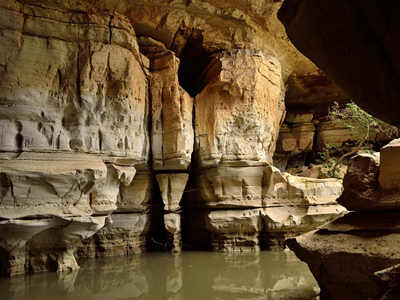 Sof Omar is one of the most spectacular and extensive underground cave systems in the world. Formed by the Wabi River, as it changed its course in the distant past and carved out a new channel through limestone foothills, the Sof Omar system is an extraordinary natural phenomenon of breathtaking beauty. The cave which is now an important Islamic Shrine, was named after the saintly sheikh Sof Omar, who took refuge here many centuries ago, have a religious history that predates the arrival of the Muslims in Bale - a history calibrated in thousands of years.
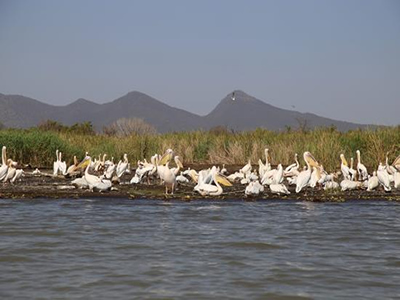 The Ethiopian Rift Valley, which is part of the famous East African Rift Valley, comprises numerous hot springs, beautiful lakes and a variety of wildlife. The valley is the result of two parallel faults in the earth's surface between which, in distant geological time (Cenozoic era), the crust was weakened, and the land subsided. Ethiopia is often referred to as the "water tower" of Eastern Africa because of the many rivers that pour off the high tableland. The Great Rift Valley's passage through Ethiopia is marked by a chain of seven lakes. Each of the seven lakes has its own special life and character and provides ideal habitats for the exuberant variety of flora and fauna that make the region a beautiful and exotic destination for tourists.
Most of the lakes are suitable and safe for swimming and other water sports. Besides, Lake Abijyata and Shalla are ideal places for aquatic bird watchers. Most of the Rift valley lakes are not fully exploited for tourist purposes except Lake Langano where tourist class hotels are built. The Rift valley is also a site of numerous natural hot springs and the chemical contents of the hot springs are highly valued for their therapeutic purposes. In short, the Rift valley is endowed with many beautiful lakes, numerous hot springs, warm and pleasant climate and a variety of wildlife. It is considered as one of the most ideal areas for short time visitors in Ethiopia.
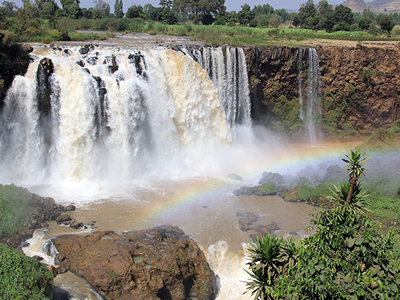 Clik here for BLUE NILE WATER FALL VIRTUAL TOUR. The river Nile, over 800 Km in length with in Ethiopia and the longest river in Africa, holds part of its heart in Ethiopia from Lake Tana, the Blue Nile, known locally as Abay, flows for 800 Km within Ethiopia to meet the White Nile in Khartoum to form the great river. It has been said that the Blue Nile contributes up to 80 % of the Nile's flow. Nowhere, is it more spectacular than where it thunders over the Tis Isat Falls literally "Smoking Water" - near Bahirdar. Here millions of gallons of water cascade over the cliff face and into a gorge, creating spectacular rainbows, in one of the most awe-inspiring displays in Africa. The Blue Nile falls can easily be reached from Bahirdar 32 KM and the scenic beauty of the Blue Nile Gorge, 225 Km from Addis Ababa, can be enjoyed as part of an excursion from the capital.
Ornithology (Birding)
Ethiopia a paradise for Ornithology, there are about 835 species of birds known to occur in Ethiopia, 23 are found exclusively within the country's boundaries. Most of these 23 endemic birds are widely distributed, chiefly on the western and southern highland plateau. Many of the semi endemic birds of Ethiopia- like Thick-Billed Raven, Wattled Ibis, Black Winged Love bird and White Collared Pigeon- are notably common over extensive areas of the plateau, and, because they are big readily identified and not especially shy, they are consequently easy to see and observe. Even in the highland forests which support comparatively few endemic species of birds, the endemics are nevertheless obvious and common. The song of one- the Abyssinian cat bird - is considered to be one of the most beautiful of any bird in Africa, Three Ethiopian Endemics are confined to the southern edge of Ethiopian plateau: they are the Streetman’s Bush-Crow, The white Tailed Swallow and Prince Ruspoli's Turaco. Another endemic Ethiopian bird, The Blue- Winged Goose, is a very isolated species: its closest relative is a Goose which occurs in South America. It is surprising that the biology of obvious and common endemic birds of Ethiopia remains inadequately known, For the Scientist, they provide a great number of interesting problems of investigation: for the tourist, they provide a very enjoyable opportunity of seeing something new and unique: for the bird watcher, they provide the experience of observing 23 birds found nowhere else in the world.