The servant of Ethiopian king (Jandereba) accepted Christianity in the year 34AD and mentioned in the bible, however it is not a state religion until the fourth century, it was long Before any European country accepted Christianity. When a Christian philosopher from Tyre named Meropius was shipwrecked on his way to India. Meropius died but his two wards, Frumentius and Aedesius were washed ashore and taken to the royal palace. Eventually they became King Ella Amida’s private secretary and royal cupbearer respectively. They served the king well, and Frumentius became regent for the infant prince Ezana when Ella Amida died. Frumentius and Aedesius were also permitted to proselytize the new religion in AXUM (as modern Ethiopia was then known). After some time, Frumentius and Aedesius returned to the Mediterranean, traveling down the Nile through Egypt to do so. When they reached Egypt, Frumentius contacted bishop Euthanasias of Alexandria and begged him to send missionaries back to AXUM, as the people there had proved so ready to receive the gospel.
Athanasius agreed that the need was urgent, and immediately appointed Frumentius to the task, which needed someone fluent in the language and sensitive to the customs of AXUM. He ordained Frumentius the first Abuna or bishop of the Ethiopian Orthodox Church. Frumentius has since come to be known as the Abuna Salama or bishop of peace. His mission was successful and, with the support of king Ezana, Ethiopia became a Christian nation.
ENKUTATASH - (Ethiopian New Year, September 11th)
This festival celebrates both the New Year and the Feast of John the Baptist at the end of the long rains in spring, when the Highlands become covered in wild flowers. Children dressed in new clothes dance through the villages, distributing garlands and tiny paintings. In the evening every house lights a bonfire and there is singing and dancing.
MESKAL - (Finding the True Cross, September 26th & 27th)
Clik here for MESKEL CEREMONY VIRTUAL TOUR.
Meskal is second in importance only to Timket and has been celebrated for over 1,600 years. The word actually means "cross" and the feast commemorates when the cross of Christ was discovered to Empress Helena, mother of Constantine the Great.
In Addis Ababa, celebrations start in the early afternoon when a procession bearing flaming torches approaches Meskal Square from various directions. Participants include Priests in brightly colored vestments, students, brass bands, contingents of the armed forces and floats carrying huge lit crosses. They circle the "demera" and fling torches upon it while singing a special Meskal song.
Thousands gather at the Square to bid farewell to the rains and welcome in "Tseday" the spring season with its profuse "Meskal" daisies and golden sunshine. As evening darkens, the flames glow brighter. It is not until dawn that the burning pyramid consumes itself entirely and the big tree at the center finally falls. During the celebrations, houses are stocked with "tella" the local beer, and strangers are made welcome.
GENNA - (Christmas, January 6th & 7th)
Year after year Christians recall the story of the Christ child in a manger, shepherds on Judean hills witnessing the celestial song of angels as they pronounced the Long Expected One had come. Celebrated on January 7th and preceded by a fast of 40 days, on the eve of Christmas people gather in churches for mass that lasts about 3 hours. The clergy and "Debtera" (scholars versed in liturgy and music of the church) lift their voices in hymns and chant just as it has been for over a thousand years when Ethiopia accepted Christianity. After mass, the fast is broken so the clergy and crowd alike disperse to their homes to feast. Food and drink is plentiful, with many homes preparing special meals that are characteristic to all big festivities highlighted on the Ethiopian calendar.
TIMKET - (Epiphany the baptism of Christ, January 18th, 19th & 20th)
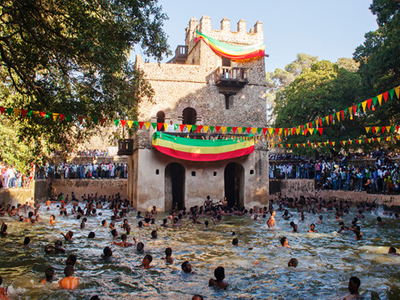
Clik here for TIMKET CEREMONY VIRTUAL TOUR. Timket is the greatest festival of the Ethiopian year, falling just 2 weeks after Ethiopian Christmas. It is actually a 3-day affair preceded by the eve of Timket when the dramatic processions take place through a night of fasting, to the great day itself and the commemoration of Christ's baptism in the Jordan River. Ketera, the Eve of Timket is when the Priests bring out the Tabots - replicas of the 2 tablets of laws received by Moses, which are normally housed inside the altar symbolizing the Ark of the Covenant. Priests bless the water of the pool or river where the next day's celebration will take place. It is the Tabot, rather than the church building which is consecrated and given extreme reverence. Visitors have the unique chance to experience a festival lost to the rest of the world.
Clik here for FACILEDES BATHTUB VIRTUAL TOUR.
FASIKA - (Fasika, variable April or May)
Fasika is one of the greatest festivals of the Ethiopian people, celebrated after 55 days of fasting. Devout followers of the Ethiopian Orthodox Church offer daily prayers at the Church and do not eat until 3 PM, except Saturday and Sunday when prayers are conducted early in the morning. Fasika always takes place in glorious weather and enormous effort is put into making the occasion memorable. Gifts are prepared for children and most people are resplendent in their best clothes, usually the dazzling white traditional dress. Everyone spends Fasika Eve at the Church praying until 3 am when it is announced that Christ has risen! This, in dramatic contrast to the brilliant jewel colors of the ceremonial velvets and satins of the priests' robes and sequined velvet umbrellas, make this festival entirely splendid
HIDAR ZION - (Celebration of St. Mary November 28th & 29th)
The Virgin is one of the most venerated of all religious figures in Ethiopia. About 33 days are annually dedicated to different celebrations in the commemoration of Mary. "Hidar Zion" is associated with the presence of the Ark of the Covenant in Axum and the belief that the Ark itself is a symbolism to her womb.This festival is attended by tens of thousands of people from all over Ethiopia making it one of the most joyous annual pilgrimages in Axum, the "sacred city of the Ethiopians." Clik here for AKSUM TSION CHURCH VIRTUAL TOUR.
KULUBI GABRIEL - (Celebration of St. Gabriel December 27th & 28th)
Almost every Christian in Ethiopia has a patron Saint and one of the most popular is Gabriel. The 28th of December and 26th of July are dedicated to the annual and colorful celebration of this Saint. The origin of the Church of St. Gabriel is traced back to the last decade of 19th century and it was Ras Mekonnen (Haile Selassie's father) who is credited with the construction. Vast crowds of people congregate on the day of this celebration. People of all ages, sexes, classes and religion gather from all corners of Ethiopia, reaching 100,000 or more. Pilgrims walk to the Church to make or fulfill a vow, to ask favors, or in many cases to give thanks for favors granted. Some carry heavy rocks on their backs, particularly for the last few kilometers uphill to the Church. Babies born through Gabriel's intervention are brought to the front of the Church for baptism. During the duration of the celebration 1,000 babies may be christened, most of them named after Saint Gabriel.

 This festival celebrates both the New Year and the Feast of John the Baptist at the end of the long rains in spring, when the Highlands become covered in wild flowers. Children dressed in new clothes dance through the villages, distributing garlands and tiny paintings. In the evening every house lights a bonfire and there is singing and dancing.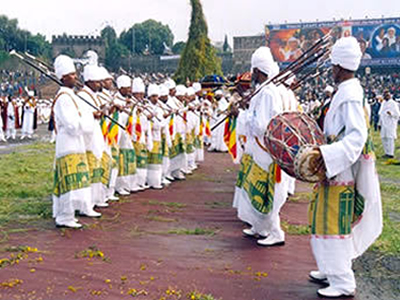
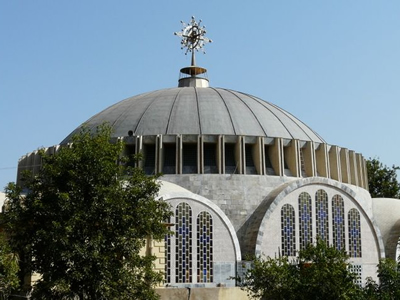 The Virgin is one of the most venerated of all religious figures in Ethiopia. About 33 days are annually dedicated to different celebrations in the commemoration of Mary. "Hidar Zion" is associated with the presence of the Ark of the Covenant in Axum and the belief that the Ark itself is a symbolism to her womb.This festival is attended by tens of thousands of people from all over Ethiopia making it one of the most joyous annual pilgrimages in Axum, the "sacred city of the Ethiopians."
