The historic route is one of the greatest treasures of Ethiopia .nowhere else in the world can you see riches of man’s past such as those in the northern part of Ethiopia. A history that stretched back to the time of prehistoric man; the 5th century B.C pagan temple of Yeha, more than 3000 years old history of Axum, the 12th century rock hewn churches of Lalibela; the medieval castles of Gonder and the famous Blue Nile fall with the 13th century walled painting monastery of Lake Tana at Bahirdar, riches that cover the history of Ethiopia. From the 1st early beginnings to the modern day, riches that are set among some of the most stunning scenery in Ethiopia and where our people work today, just as their ancestors have done for generations.
Ethiopia’s historic route begins with a glance at the enticing remains of Yeha-the center of the earliest civilization in northern Ethiopia .the journey takes you on rough tracks through the dramatic highland scenery ending in a serene agricultural hamlet. Yeha, which lies to the northeast of Axum, is the site of the famous Temple of the Moon, Ethiopia's oldest standing structure. It is generally agreed the Temple of the Moon was built during the time of the D’mt Kingdom in the 8th and 7th centuries BC. The D'mt Kingdom preceded the Axumite Kingdom. When and how the transition from the D'mt Kingdom to the Axumite Kingdom occurred has not yet been determined. The oldest standing structure in Ethiopia is located in Yeha: the Great Temple. This is a tower built in the Sabaean style, and dated through comparison with dated structures in South Arabia to around 700 BC; although no radiocarbon dating testing has been performed on samples from Yeha, this date for the Great Tower is supported by local inscriptions. David Phillipson attributes its "excellent preservation" to two factors, "the care with which its original builders ensured a level foundation, firmly placed on the uneven bedrock; and to its rededication perhaps as early as the sixth century AD -- for use as a Christian church. Two other archeological sites at Yeha include Grat Beal Gebri, a ruined complex distinguished by a portico 10 meters wide and two sets of square pillars, and a graveyard containing several rock-hewn shaft tombs first investigated in the early 1960s. One authority has speculated that one of these tombs contained a royal burial, while another believes the ancient residential area was likely one kilometer to the east of the modern village
Yeha is also the location of an Ethiopian Orthodox monastery, founded according to tradition by Abba Aftse, one of the Nine Saints. In his account of Ethiopia, Francisco Álvares mentions visiting this town in 1520 (which he called "Abbafaçem"), and provides a description of the ancient tower, the monastery, and the local church. This church was either the rededicated Great Temple, or a now destroyed building which the Deutsche Aksum-Expedition described in the early 20th century. (The current structure, which exhibits Aksumite architectural features, was built between 1948 and 1949. Yeha has also been the site of a number of archaeological excavations, beginning in 1952 by the Ethiopian Institute of Archeology. Although interrupted during the Derg regime, excavations were resumed in 1993 by a French archaeological team. Clik here for YEHA VIRTUAL TOUR.
Debre Damo monastery
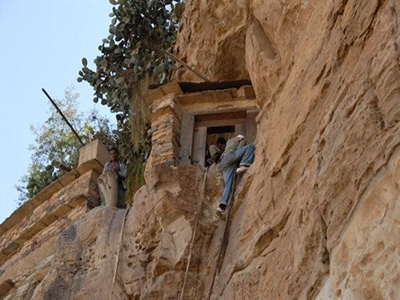
Debre Damo monastery is situated on an isolated mountain in northern part of Tigray. Some three hours drive from Axum with the recently restored road and an additional one hour hard ascending walk from the point where the road ends. (Depending on your fitness) lies, the spectacular monastery of Debre Damo, it is unique compared with most Ethiopian monasteries. Debre Damo was built in the 6th century AD with curved wood plates, painting ceilings and walls dedicated to the ledged of Saint Abune Areggawi, the history of Debre Damo is core on the Nine Saints who came to Ethiopia from Syria and other Europe empires in the 6th century during the reign of Kaleb and Gebremeskel to widen Christianity in the country particularly the northern part of Ethiopia. Among them Abune Areggawi came to this flat top mountain to establish and dwells on the mountain of Debre Damo
Debre Damo is only accessible by climbing up a rope, which is made up of animal leather lowered from the cliffs, which visitors tie around their waist and are then pulled up by a monk at the top of the cliffs. It’s only permitted to men and male animals, women and even female animals are prohibited to enter. It’s magnificent in terms of its location and extensive collection of priceless manuscripts that have remained intact till present time. It has become a prominent monastic and spiritual educational center for Ethiopian Christianity for centuries, many books and manuscripts have been written and translated to Ge’ze on animal skins and distributed throughout the country.
The monastery
The monastery received its first archeological examination by E. Littman who led a German expedition to northern Ethiopia in the early 20th century. By the time David Buxton saw the ancient church in the mid-1940s, he found it "on the point of collapse” a few years later, the English architect D.H. Matthews assisted in the restoration of the building, which included the rebuilding of one of its wood and stone walls (a characteristic style of Aksumite architecture) Thomas Pakenham, who visited the church in 1955, records a tradition that Debre Damo had also once been a royal prison for heirs to the Emperor of Ethiopia, like the better known Wehni and Amba Geshen The exterior walls of the church were built of alternating courses of limestone blocks and wood, "fitted with the projecting stumps that Ethiopians call 'monkey heads.'" Once inside, Pakenham was in awe of what he saw:
The church of Debre Damo
When you gain the nave of the church, the full excitement of the architecture was apparent. The stones holding up the roof piers were actual Axumite relics incorporated in the Christian structure; while the doors and windows which held up the roof were all Axumite in style; their twisted frames were of exactly the same design as those on the obelisks I had seen at Axum. But the demands of the Christian church had produced entirely un-Axumite features. Below the nave roof a 'clerestory' of wooden windows let in a dim religious light from the outside world. And just visible above the ubiquitous draperies that shrouded the church in hieratic gloom, we could see a chancel arch leading to the sanctuary. It was exciting to see, here in this fortress above the wastes of Moslem Africa, features cast in the strong mould of the basilicas of early Christendom.
Rock churches of Tigray
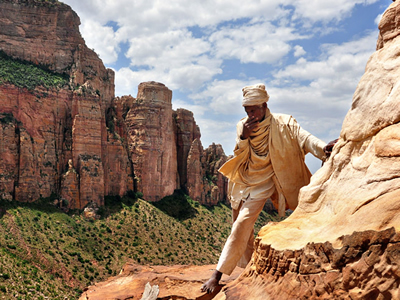
Over 125 rocks hewn churches are recorded in Tigray region. The rock churches of Tigrai do not function primarily as tourist attraction they were generally excavated using a very different method from that at Lalibela, the antiquity of most of the Tigraian rock-hewn churches remains largely a matter of speculate. Every church has its own oral tradition regarding its excavation, in many cases the church is dated to the reign of Abreha-we-Astebeha the twin Emperors of Axum who converted to Christianity in the middle of the 4th century. There are a number of explanation given as to why the rock-hewn churches of Tigrai were so often carved in to relatively inaccessible cliff face, was it for security, or for spiritual isolation, or simply because cliff face are inherently good place to carve churches and cliff face are inherently inaccessible? Certainly the mentioned facts keep away outsiders and made the rock churches intact.
Some of these rock hewn churches are pre-Christian temples, which was changed to church after the spread of Christianity in the northern Ethiopia. Most of these churches are difficult to access since they are carved on the top of the cliff, thus visitors who are interested to visit have to be physically fit, the rock churches can be visited form the Mekele or on the way to Axum, from this wokro Churckos and Abreha-we-Astebeha are the most reachable. Most of these churches are found on the Gera-Alta chained Mountains Also these magnificent churches can be visited on the eastern and southern Tigray area. According to client interest we organize a special tour package which will combine trekking and camping.
Axum is the ancient kingdom that flourished in northeastern Africa from the 1st century BC until the early 7th century AD. The ruins of the ancient city of Aksum are found close to Ethiopia's northern border on the heart of ancient Ethiopia was once the capital of Ethiopia. It is known for its historical and pre-historic relics. The origins of the Kingdom of Axum in 5th century BC are most frequently accepted as the event commencing the history of Ethiopia. In the times of its greatest prosperity, the Kingdom was maintaining political and commercial contacts with the civilizations of Greeks and Romans, and also with India and China. In the times of Kingdom of Axum, the Geez language became an official one until today, it has been in use in the churches of Ethiopia Legend has, that it was once the seat of the Queen of Sheba or Makeda (as the Ethiopians call her) who reigned over the region in the 10th century B.C. The Axum obelisks were carved out from a single granite stone and are the world’s tallest monolithic art work. It is believed that they were erected some 2000 years ago. They are unique in their architectural beauty and mysterious past. Axum is also known as an archaeological site where one can find historic and pre-historic relics unearthed through continuous excavations. These items are displayed in the museum at Axum.
In accordance with a legend, it is from here that the Queen of Sheba departed in order to meet King Solomon. The Ethiopian epic the Kibre Negest (glory of kings) tells us that Menilik I, the son of the queen of Sheba and king Solomon of Israel, brought the original Ark of the Covenant from Jerusalem to Axum, there by established one of the world’s longest known and uninterrupted monarchical dynasties called the Solomonic dynasty. Impressive ruins, monuments and archeological artifacts abound in and around Axum attesting to the solid, articulate, confident, literate and resourceful strength of the civilization.
Referred to as the head of the all Ethiopian churches, Axum’s St. Mary of Zion climes to be the custodian of the original Ark of the Covenant brought by Menilik I .Axum’s most popular attractions includes as you gaze on the magnificent steals or obelisks, the tomb of king Kaleb and King Gebre Meskel, and the legendary palace and bath of queen Sheba.
Clik here for AKSUM VIRTUAL TOUR.
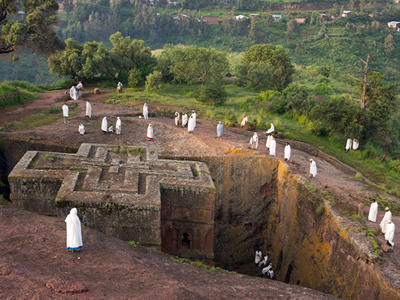
The extraordinary, isolated town of Lalibela, set high in the mountain of Lasta the foothills of the chain mountain called Abuna Yosef situated on the south direction of Axum. After the fall of the Kingdom of Axum, the kings from the Zagwe dynasty transferred their residence to Lalibela, the south-east of Axum. There, they erected a flourishing and densely-populated capital city, the residence of their Middle Age dynasty. Lalibela, previously known as Roha, was called in this manner to commemorate the King of Lalibela from the end of 12th century. The city was established as New Jerusalem. In that historical period, travelling on pilgrimages to proper Jerusalem was impossible, because the lands between Jerusalem and Ethiopia had been conquered by Muslims. The churches of Lalibela leave no one disinterested. These intriguing edifices have in their entirety been forged out in a homogeneous lump of red volcanic tuff. They seem to be absolutely unreal and created by some kind of a superhuman power. Rock temples might be admired in different places in the world, but it is solely here that not only the internal space, but also facades and external walls have been forged out. The churches of Lalibela are referred to as the least known of the eight miracles of the world, and they full deserve that name. The buildings are in their entirety forged out in rock, and, simultaneously, completely separated from that. In the subsequent centuries, Lalibela was gradually decreasing in importance, so as to become a small village. Famed for its rock- hewn churches, and is arguably the one place in Ethiopia that no tourist should miss, Lalibela served as the capital of the Zagwe dynasty ,which ruled over Ethiopia from the 10th century to the mid of 13th century. Monolithic Saint George’s Church, having the characteristic shape of the Greek cross, evokes admiration. The largest church is Bet Medhane Alem, and it is 33 meter long, 23 meter wide and 11.5 meter high. The king of Lalibela employed 40 thousands of workers to excavate it. A legend has it that the workers were laboring throughout a day, and at night their work was continued by Angels with doubled strength. Why were these churches not erected of stone, in a more ordinary manner? The answer to this question has remained unknown until today. One of the hypotheses claims that such a manner of constructing safeguarded them against ending up destroyed in the case of the invasion of enemies. New Jerusalem does not offer only rock churches, but also underground dark corridors, on which the footsteps of deacons are still to be heard.
No matter you visited other rock –hewn churches in Ethiopia, noting will prepare you for these. The Lalibela churches are big several are in excess of 10 meter high and because they are carved below ground level, they are ringed by trenches and courtyards, there sides of which are cut in to with stone graves and hermit cells ,and connected to each other by a tangled maze of tunnels and passages. Each individual churches is unique in shape and size, precisely carved and minutely decorated. Lalibela is, in a word, awesome. When the Portuguese priest Francisco Alvares was taken to Lalibela in 1521, he doubted that his compatriots would believe what he has seen.
Clik here for LALIBELA VIRTUAL TOUR.
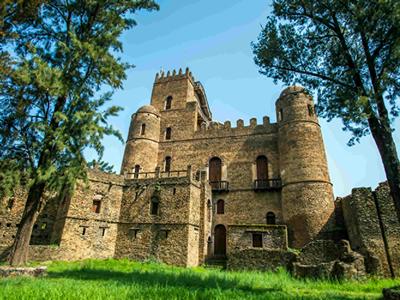
Gonder, the cross roads of Ethiopian civilization, is located 50km north of lake Tana, 740 km north of Addis Ababa and situated in the foothills of the simian mountain at an altitude of 2,200meters above sea level .Gonder served as the capital of Ethiopia for more than 200 hundreds years from the rise of Fasiladas (1636-67) to the fall of Tewodros (1855-68) instruction in painting, music dance, poetry and many other disciplines thrived. Because of the focus on arts and architecture it has been labeled the Camelot of Africa. Gonder is famous for its massive ruins of imposing castles which depict the old days of our emperors and the skill and the craftsmanship used in the building of these several castles. The city was once a vigorous and vital center of religious learning and art the oldest and most impressive one is the two storey palace of emperor Fasiladas, built from roughly brown basalt stones. it reflects a number of architectural influence of Axumit, portages and Indian, the upper story offers panoramic views and lake Tana is visible on a clearer day , the castle has been renovate recently by the fund of UNSCO ,the castle compound is registered as world heritage.
The Debre Berhan Selassie (Trinity and Mountain of Light) Church in Gondar is famed for its beautiful examples of Ethiopian church art. Built by an emperor and preserved by an archangel, it is also among the most important churches of Ethiopia. The outside of Debre Berhan Selassie is rather plain, but its interior has made it one of Ethiopia's top tourist attractions. The walls depict biblical scenes and saints and the ceiling is covered with the faces of hundreds of angels. Icons of the Holy Trinity (three identical men with halos) and the Crucifixion have pride of place above the entrance to the Holy of Holies. Another attraction worth visiting is the bathing place of Emperor Fasildas. Their baths are filled with water every year for the Timket (Epiphany) ceremony which is an Orthodox holiday celebrating the baptism of Christ. Once the baths are filled with water the crowd jumps in the pools shouting and laughing.
Clik here for GONDAR VIRTUAL TOUR.
Situated on the southern extremity shoreline of Lake Tana, Bahirdar is a decidedly attractive town with palm-lined avenues and pretty lakeside vistas. Nearby Lake Tana, 1,800 meters above sea level, is one of the long hidden source of the Blue Nile. The Tiss Isat falls (meaning water that smokes) are 32 kms down from where the Blue Nile leaves the lake towards Khartoum. Approached by foot up a long winding path and crossing a 17th century bridge built by Emperor Fasiledes, the falls cascade down 45 meters over a 400mts area. Lake Tana's 3600 sq.kms the third largest lake in Africa and the first from the country, surface is dotted with more than 30 islands, many of which are the sites of monasteries and churches, some dating from the 14th century in the reign of Emperor Amde Tsion. A motor boat takes you from the charming market town of Bahirdar to Ura Kidanemihret, a monastery on the mainland peninsula at Zegie, where a treasury of ancient illuminated bibles is stored. Along the way, papyrus canoes are used by the local people since ages past for fishing and gathering firewood.
The thirty seven islands of Lake Tana Ethiopia's Largest Lake, Shelter twenty Monasteries surviving remnants of an old, contemplative tradition. The power of Blue Nile may best be appreciated at the Blue Nile Falls, the most dramatic spectacle on either the White or Blue Niles, a vision of natural strength and grandeur. For the modern traveler, the starting point of any visit to the Blue Nile Falls, or to the islands of Lake Tana, is the bustling market town of Bahirdar on the Lake's south-eastern shore. The multihued markets and a variety of handicrafts and weaving axis make it a comfortable base for excursion either by land or water.
Bahirdar port provides access by boat to a number of historic lakeside churches and monasteries, near and far. Most date from the seventeenth century and have beautifully painted walls. Many such places of worship now have fascinating museums, at which the visitor can see priceless illustrated manuscripts, historic crowns and fine royal and ecclesiastical robes. Some monastic land mass are forbidden to women, but others can be visited by both sexes.
Clik here for BAHIRDAR VIRTUAL TOUR.
Harar - The walled city of exotic mosaic culture
No journey along Ethiopia’s great historic route would be complete without a visit to the medieval walled city of Harar, which stands among green mountains (at an elevation of 1885 meters) on the east wall of the Great Rift Valley 500 km from Addis Ababa and near to the Somali border, with its more than 90 mosques and shrines, is considered the fourth most sacred center of the Islamic world, registered by UNSCO as world heritage in 2008
Harar was founded between the 7th and the 11th century. In the sixteen century Harar, under sultan Abu Bakr ibn Muhammad, became the capital of an independent Muslim kingdom. In the same century the great walls with five gates surrounding Harar were built to keep out powerful neighboring hostile groups. In the nineteenth century Harar was incorporated into Ethiopia’s growing Empire. Harar has, for centuries, been the main centre for Islamic learning and culture in Ethiopia, and a prosperous centre for caravan trade linked by trade routes with the rest of Ethiopia, the Horn of Africa, the Arabian Peninsula & the outside world. Harar is considered by some to be the fourth holiest Muslim city in the world with its around 90 mosques three of which date from the 10th century with 102 shrines located in a small city less than one square mile.
The Hyena man is considered to be a tourist attraction of Harar; for a few dollars you can see or even experience feeding the hyenas in the evening. This long-standing tradition of feeding the carnivores at night began in 1960. The French poet Arthur Rimbaud has lived in Harar as a trader in the nineteen century, and now travelers may visit his place of living called “Rimbaud house” which is an impressive, beautiful mansion in restoration.
Harar has an ethnically complex population made up of Adares, the indigenous highland Ethiopian People of this region who speak a Semitic language related to Amharic, Arabs, Oromo’s and Somalis from the plains. This cultural diversity is best expressed in the old market as a centre of the city where tall, graceful maidens in long, flowering, extravagantly colored dresses come to barter and buy amongst the elegant Moorish archway. Rightly renowned for its intricately worked jewelers of silver, gold and amber, Harrari's Magalo Gudo market is also a centre of beautiful basket of woven grass, decorative wall mats and bright shawls, as well as fruit, vegetables, spices and grains of the province and a warren of streets. Travelers may wander on narrow, cobbled alleyways twisting from the market until they reach one of the five gates in the city wall, or visit the former house of Haile Selassie that is momentarily used by a healer, who by using herbs is able cure lots of diseases, or else enter
Dire Dawa
Dire Dawa is city in Harar region. It is a commercial and industrial center located on the Addis Ababa–Djibouti railroad. Manufactures include processed meat, vegetable oil, textiles, and cement. There are also railroad workshops in the city. Dire Dawa was founded in 1902 when the railroad from Djibouti reached the area, and its growth has resulted largely from trade brought by the railroad place of interest in this very interesting town is the local market and the railway station with the old trains.